UN Global Compact Network Angola and the Central Bank of Angola Champion Gender Equality and Inclusive Leadership in the Financial Sector
UN Global Compact Network Angola and the Central Bank of Angola Champion Gender Equality and Inclusive Leadership in the Financial Sector
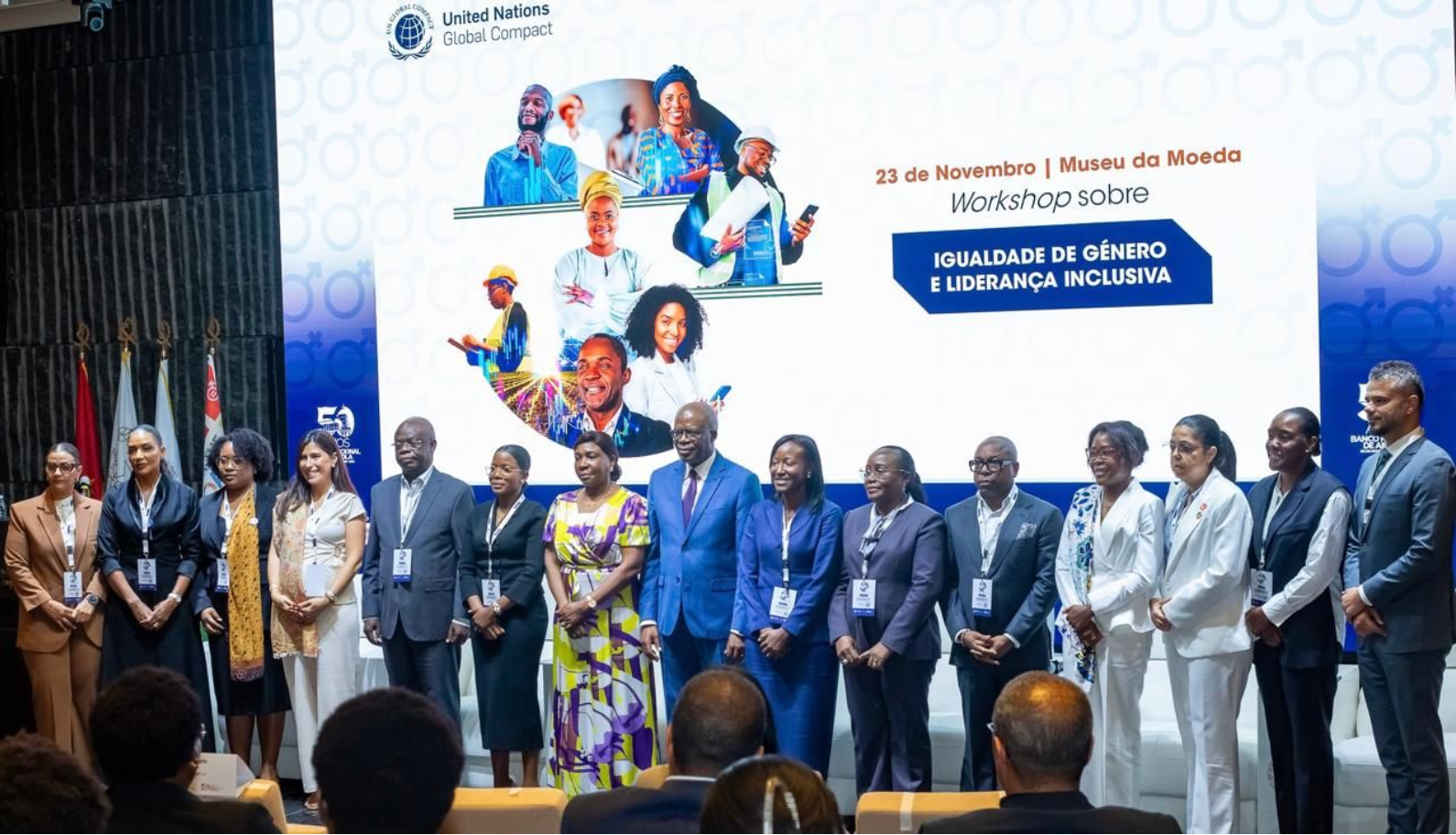
Efforts to advance gender equality and promote more inclusive leadership in Angola’s financial sector gained renewed momentum on 24 November, as the Currency Museum hosted a high-level Workshop on Gender Equality and Inclusive Leadership, organised by the Central Bank, Banco Nacional de Angola (BNA) in partnership with the UN Global Compact Network Angola.
Involving for the first time the Central Bank in the implementation of the Ten Principles, the workshop brought together leaders, regulators, experts and representatives of financial institutions to examine persistent barriers to gender equality, explore the importance of diversity in decision-making spaces, and highlight the role of inclusive leadership in building a fairer, more competitive, resilient and sustainable financial sector.
The event underscored the importance of moving beyond commitments to concrete institutional action, recognising that greater gender representation and equal opportunities in leadership are essential to strengthening governance, broadening perspectives and unlocking the full potential of Angola’s financial ecosystem.
Advancing gender equality through institutional leadership
Dr. Manuel Tiago Dias, Governor of the Banco Nacional de Angola, led the opening session through a presentation, during which she highlighted the critical need to accelerate progress on gender equality while expanding women's representation in decision-making and leadership roles.
Eliana Pereira dos Santos, Executive Director, UN Global Compact Network Angola, shared perspectives on the importance of diversity, market awareness and the adoption of good practices to advance gender-inclusive leadership.
"Promoting gender equality and diversity in the business and financial environment in Angola is crucial to overcoming homogeneous views and driving sounder decisions, requiring the transformation of structures that still perpetuate inequalities in access to opportunities and leadership roles."
The workshop also featured a presentation by Alexandra Moutinho, Director of PwC Angola, who shared data, insights and strategic recommendations to advance gender equality in the financial sector. Complementing this perspective, Denise Pinheiro presented Banco de Fomento Angola (BFA)'s policies, initiatives and progress in promoting Diversity, Equity and Inclusion (DEI), offering practical insights into institutional approaches to building more inclusive workplaces.
From dialogue to action: Advancing inclusive leadership
A central highlight of the workshop was a panel discussion moderated by Cecília Fernandes, bringing together Rosa Kajibanga, Kelline Monteiro, Odyle Cardoso, Marcelo Barreto and Irene Graça.
The discussion examined practical measures to accelerate the transformation of Angola’s financial sector, with participants reflecting on the importance of addressing structural barriers, strengthening institutional policies and creating an enabling environment in which women can access leadership opportunities and participate fully in decision-making.
A shared commitment to a more inclusive financial sector
The official closing session was led by the Secretary of State for Family and the Promotion of Women, Dr. Alcina Lopes, who reaffirmed the government's commitment to advancing gender equality and strengthening efforts to promote women's empowerment and participation across different sectors of society.
With the financial sector representing over one third of the Global Compact participants in Angola, the workshop reinforced a shared understanding that gender equality is not only a fundamental component of sustainable development but also a strategic driver of financing institutions and overall socioeconomic progress.
As part of its broader commitment to responsible business practices, the UN Global Compact continues to engage businesses and institutions in advancing gender equality, promoting inclusive workplaces and strengthening women's leadership. These efforts are aligned with the Ten Principles and the Sustainable Development Goals, particularly SDG 5 – Gender Equality, which calls for the achievement of gender equality and the empowerment of all women and girls.