African Private Sector at COP28

The Africa Business Leaders Coalition presents the African Private Sector Reception.
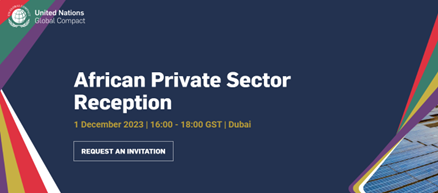
The Africa Business Leaders Coalition presents the African Private Sector Reception. This in-person reception will bring together business leaders from Africa and around the world, high-ranking Government Representatives and the United Nations to engage in public-private dialogues and help accelerate climate action on the continent. This event is supported by Airtel Africa.


The event will kick-off with keynote addresses delivered by the UN Global Compact, Airtel Africa and high-level guest speakers. Following the keynote addresses, we invite you to join us for an exclusive cocktail reception to continue these enriching discussions.


Request an invitation


The African Private Sector Reception at COP 28, jointly hosted by the UN Global Compact Africa Business Leaders Coalition (ABLC) and Airtel Africa plc, will convene top-tier executives, heads of private sector entities, heads of states, government officials, and intergovernmental organization representatives to discuss initiatives to propel climate action and sustainable development across Africa.


The event aims to foster engagement between the private and public sector on climate action to underscore the importance of collaboration in shaping an environment to accelerate climate action, including mitigation, adaptation, and resilience. It will serve as a platform for the private sector to share insights on the regulation required to propel trade and investment into Africa.


Speakers

H.E. Mokgweetsi Masisi, President of Botswana
Sanda Ojiambo - CEO and Executive Director, UN Global Compact
Olusegun Ogunsanya - GCEO, Airtel Africa plc
Other High-level speakers to be confirmed


ABLC is a pan-African CEO-led initiative emanating from the UN Global Compact Africa Strategy 2021–2023. It includes over 55 companies representing $150bn in revenue and over one million employees. It provides a platform for African business leaders to have a unified private sector voice as they actively and meaningfully engage on the continent’s most pressing issues through an organized, forward-looking, principles-based approach. The coalition has been instrumental in driving collective climate action through the Africa Business Leaders’ Climate Statement endorsed at COP 27. At COP 28, the ABLC will announce its progress to date.


As a pivotal member and Advisory Council participant since 2022, Airtel Africa plc contributes significantly to shaping the ABLC’s climate advocacy strategies. Operating across 14 African countries, Airtel Africa plays a crucial role in propelling the coalition towards achieving its ambitious climate goals.


Notes to Editors


About the UN Global Compact

As a special initiative of the United Nations Secretary-General, the UN Global Compact is a call to companies worldwide to align their operations and strategies with Ten Principles in the areas of human rights, labour, environment and anti-corruption. Our ambition is to accelerate and scale the global collective impact of business by upholding the Ten Principles and delivering the Sustainable Development Goals through accountable companies and ecosystems that enable change. With more than 18,000 companies and 3,800 non-business signatories based in over 101 countries, and 62 Local Networks, the UN Global Compact is the world’s largest corporate sustainability initiative — one Global Compact uniting business for a better world. For more information, follow @globalcompact on social media and visit our website at unglobalcompact.org and Africa Business Leaders Coalition 


About the Africa Business Leaders Coalition (ABLC)

The Africa Business Leaders Coalition (ABLC) is a CEO-led initiative emanating from the UN Global Compact Africa Strategy 2021–2023 committed to advancing sustainable growth, prosperity, and development in Africa by bringing measurable impact to its most pressing issues. The ABLC works closely with the UN Global Compact Hub in Abuja and 10 African Local Networks operating across Africa.


Airtel Africa plc

Airtel Africa is a leading provider of telecoms and mobile money services, with a presence in 14 countries in Africa and a commitment to reduce its Scope 1 and 2 greenhouse gas emissions (GHG) emissions intensity by 62% from baseline by 2032 and achieve net zero ahead of 2050.


Contact

For media inquiries and additional information, please contact:
Natalie Vinters

nvinter@hudsonsandler.com

November 24, 2025
UN Global Compact Regional Open House
November 12, 2025
UN Global Compact Network Tunisia Marks 10 Years of Sustainability Leadership with Forum on Climate Action
November 7, 2025
DRC’s Private Sector Mobilized for Action at Economic Forum on Sustainable Sanitation in Kinshasa
November 5, 2025
UN Global Compact Network Ghana Hosts Final Solutions Showcase to Advance SDG Innovation
November 3, 2025
Unstoppable Africa 2025: Summary of Outcomes, Announcements & Forward Looking
October 10, 2025
Lusaka, Zambia –9 October 2025 – The 4th African Business and Human Rights Forum (ABRH) concluded today in Lusaka, Zambia, bringing together more than 600 participants, including business leaders, governments, civil society, Indigenous Peoples, national human rights institutions and international partners, to advance the implementation of the United Nations Guiding Principles on Business and Human Rights (UNGPs) across Africa. The Forum, held from 7 to 9 October under the theme “From Commitment to Action: Advancing Remedy, Reparations and Responsible Business Conduct in Africa,” was co-organized by several partners, including the African Union, the UN Global Compact, UNDP, the UN Working Group on Business and Human Rights, UN Human Rights (OHCHR), the African Commission on Human and Peoples’ Rights (ACHPR) and UNICEF. This year’s Forum aligned with the African Union theme, “Justice for Africans and People of African Descent Through Reparations.” Participants focused on concrete steps to strengthen remedy and reparations frameworks and to promote responsible business conduct in the context of Africa’s evolving economic and regulatory landscape. The Forum has become a critical platform for moving from policy to practice, accelerating implementation, and highlighting regional solutions to ensure that businesses in Africa uphold human rights while contributing to inclusive and sustainable development. Over three days, the Forum featured high-level panels, roundtables and clinics, alongside a dedicated UN Global Compact Networking Event. These sessions provided space for governments, businesses and rights holders to exchange experiences, showcase innovations and build partnerships to translate high-level commitments into tangible action. Discussions centred on four priority areas: Strengthening access to remedy for victims of business-related human rights and environmental harms through improved policy frameworks, stronger judicial capacity and more effective grievance mechanisms; Advancing reparations by emphasizing the shared responsibility of states and businesses to address historical and ongoing injustices; Promoting responsible business conduct by embedding human rights due diligence across operations and aligning with regional frameworks such as the African Continental Free Trade Area (AfCFTA) and the draft AU Business and Human Rights Policy; and Enhancing transparency and accountability through digital tools, improved reporting and collective monitoring of commitments. Speaking at the opening of the Forum, Hervé Lado, Africa Head of the UN Global Compact, underscored the urgent need for businesses to embed human rights into their operations and lead by example. “The theme of this year is a call to action for effective remedy, an invitation to go beyond protect and respect. As we develop our new global strategy 2026-2030, we want to equip more businesses in Africa by 2030 with knowledge, expertise and more ambition in upholding the Ten Principles and implementing adequate and effective remedies where their activities have caused adverse impacts. How companies respect human rights and implement remedies is central to building resilient and inclusive economies,” Lado said.
October 7, 2025
UN Global Compact Network Ghana's Summit Sparks Transformation of Food Systems for a Sustainable Future
October 3, 2025
The UN Global Compact Africa Regional Hub in Chad, recently joined the Office of the UN Resident Coordinator to convene a capacity-building and exchange workshop with leaders of small and medium enterprises (SMEs), government representatives and business associations. The session which was held on the 29 and 30 September 2025, revealed a significant opportunity: many SMEs are already contributing to the Sustainable Development Goals (SDGs), often unknowingly, through their daily operations. For example, a local dairy producer discovered that his business directly advances SDGs 1 and 2, and committed to formalising corporate social responsibility practices to deepen his company’s contribution. This experience reflects a broader challenge on SDG awareness among the private sector. While national development plans give the private sector a central role—Chad’s national development plan “Chad Connection 2030” allocates 46 percent of anticipated investments to private actors—, awareness of the SDGs remains limited. Yet evidence shows that private sector engagement is indispensable. Unlocking private sector investment in these sectors, alongside infrastructure and renewable energy, could accelerate growth and resilience. According to the World Bank and International Finance Corporation (IFC), agriculture and pastoralism account for more than half of Chad’s GDP, with 73 percent of households depending on them for income . Yet, awareness of the SDGs among businesses remains low. At the same time, Chad’s new national development plan, Chad Connection 2030, targets over US$30 billion in investment by 2030 , with the private sector expected to play a decisive role. While in N’Djamena for the capacity-building and exchange workshop, Dr. Hervé Lado, Head of the UN Global Compact Africa Regional Hub, urged participants to embrace SDG-centered efforts in their business operations. “Leveraging the momentum from the 80th Anniversary of the UN, the 25th Anniversary of the UN Global Compact and the recent UN General Assembly, the private sector, the government and the UN system in Chad are called to enhance collaboration and catalyze partnerships to accelerate the achievement of the national development plan and the SDGs for the benefit of the populations,” Dr. Lado, expressed. Encouragingly, international partners are stepping up. Afreximbank has pledged up to US$1.5 billion to boost Chad’s private sector , particularly in agriculture and agro-industry. Combined with improved awareness, such commitments demonstrate how local enterprises can transition from being passive beneficiaries of development to active drivers of sustainable change. Strengthening dialogue and capacity building will be essential to ensure that businesses across the Sahel can fully align with the 2030 Agenda and mobilise the investments needed for inclusive and sustainable development.
September 10, 2025
GABI: Advancing African Competitiveness in a Climate-Regulated World at Unstoppable Africa 22 September 2025 | 9:00 AM to 10:30 AM EDT (3:00–4:30 PM CAT) The UN Global Compact Africa Hub and UNGC's Country Networks in Africa will host a high-level session titled “Navigating CBAM: Advancing African Competitiveness in a Climate-Regulated World” at the Global Africa Business Initiative (GABI): Unstoppable Africa 2025. Scheduled for 22 September 2025 from 9:00 AM to 10:30 AM EDT (3:00–4:30 PM CAT) at the Marriott Marquis Hotel in New York City. Europe represents almost one-third of Africa’s trade and it is projected that if the European Union’s CBAM (Carbon Border Adjustment Mechanism) is fully applied to all imports, Africa’s exports to the EU will plunge by 5.72% and Africa’s GDP cut by 1.12%, posing urgent economic and strategic challenges for the continent. This dialogue will unpack the implications of the CBAM, showcase corporate climate action by African businesses, explore pathways to green industrialization, enhanced competitiveness, equitable inclusion in global sustainability governance, and boosted intra-Africa trade. To attend, select the event in the GABI app and join leaders from business, finance, and policy in shaping a resilient, unstoppable Africa.
September 1, 2025
Efforts to drive private sector investment in the Sustainable Development Goals (SDGs) in Rwanda received a significant boost as seven new companies pledged to join the United Nations Global Compact during a recent high-level Partners’ Forum in Kigali. This was further underscored during the Partners’ Forum, held under the theme “Can Do with Integrity” and organized in collaboration with MTN Rwanda and Mobile Money Rwanda on 7 August 2025. The forum, which brought together stakeholders in the Rwandan business ecosystem such as suppliers, vendors, franchises and other partners, was attended by over a hundred participants from various companies and received strategic support and guidance from the UN Global Compact. The commitments followed a presentation by the UN Global Compact on its value proposition and the benefits of joining the largest global sustainability initiative. Specifically, the forum served as an opportunity for the UN Global Compact to recruit new businesses to join its future Country Network and support them to address critical areas of regulatory compliance, fraud prevention and anti-bribery measures, procurement processes and standards, and ethics and integrity in business operations. During the engagement, the UN Global Compact reported on its progress in Rwanda, where the membership has grown from 1 to 27 companies since 2023, across sectors including banking, energy, mining, telecommunications, and construction. While Rwanda shows strong growth and retention; the relatively small size of the national economy and local businesses means that achieving viability for the network will require welcoming a hundred businesses.
SHOW MORE ▶