Rwanda’s Drive for ESG Practice Receives Significant Boost Through The UN Global Compact Training
Rwanda’s Drive for ESG Practice Receives Significant Boost Through The UN Global Compact Training
As the global business landscape increasingly values sustainability, Environmental, Social, and Governance (ESG) standards are becoming essential benchmarks for responsible and competitive corporate behaviour. These standards guide companies in measuring and reporting their performance on critical issues such as climate action, human rights, labour conditions, diversity and inclusion, anti-corruption, and corporate governance.
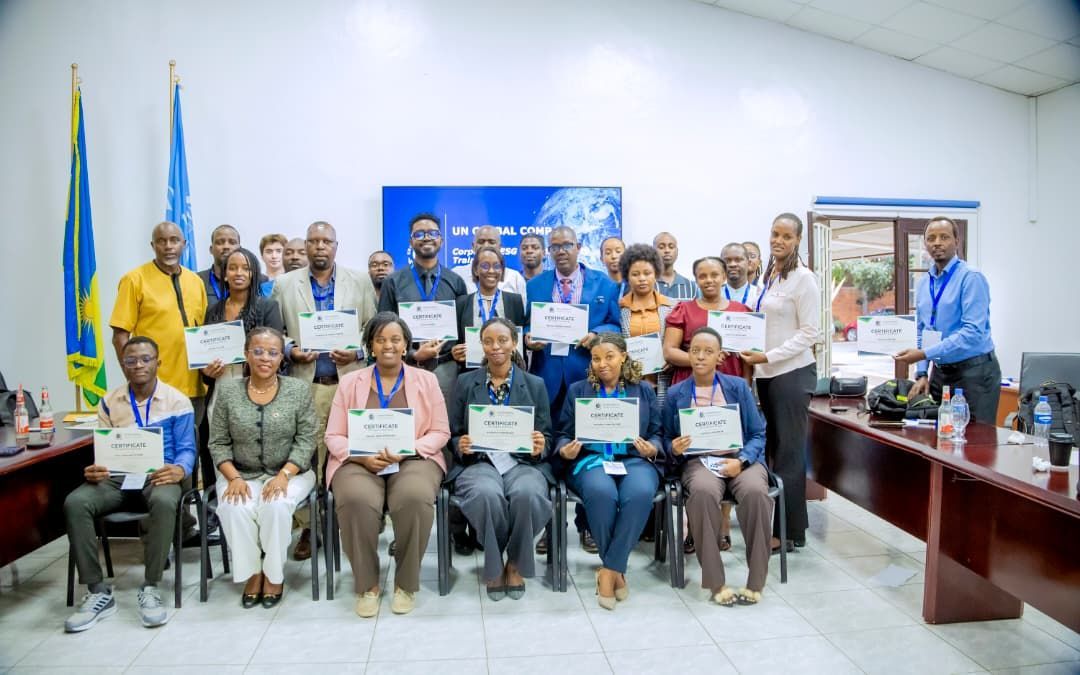
In Rwanda, sustainability is gaining traction, driven in large part by the efforts of the United Nations Global Compact (UNGC). The Global Compact promotes responsible business conduct worldwide, encouraging companies to align their operations with its Ten Principles across human rights, labour, environment, and anti-corruption. Today, 30 Rwandan organizations are registered as UNGC participants, with many seeking deeper guidance on how to effectively integrate ESG principles into their strategies and reporting practices in line with global standards. Along this line, on 19 November 2025, the UN Global Compact convened its Corporate ESG & Sustainability Training in Rwanda under the theme: “Embedding ESG for Sustainable Business Growth in Rwanda: From Compliance to Value Creation.”
Designed for corporate executives, sustainability managers, compliance officers, and policymakers, the one-day training underscored the shift from a compliance-driven approach to one that positions ESG as a catalyst for innovation and long-term value creation. Anchored in Rwanda's Vision 2050 and green growth agenda, the participants received practical tools, exposure to global frameworks, and insights from peer organizations to improve competitiveness, manage risks, and build stakeholder trust.
The workshop was developed to support Rwanda’s private sector transformation and to advance the UNGC’s broader mission of responsible and sustainable business conduct. Participants learned about the basics of ESG standards, how to integrate ESG into business strategy and governance, and major global frameworks and disclosure requirements, including the UN Global Compact’s Communication on Progress (CoP). The workshop also included practical demonstrations of tools and resources that will enable companies to carry out materiality assessments and navigate ESG learning platforms.
“Over the last few years, our work in Rwanda has created a strong desire among businesses for more robust tools, methods, and frameworks around corporate sustainability and ESG standards. This training is part of our effort to meet that need. This training is not just about understanding ESG principles, but also about equipping companies to integrate these principles into their daily decision-making and long-term strategy. When businesses grow responsibly, entire communities benefit, and together we move closer to the future we want”, said Marie Claire Dushimumukiza, Country Manager, UN Global Compact Rwanda.
The training brought together 42 attendees, including 37 current participants of the Gobal Compact and 5 prospective members. Programme delivery included:
- Interactive Workshops: Expert presentations, hands-on demonstrations, and group discussions.
- Practical ESG Guidance: Tailored support on applying ESG frameworks and using tools for implementation and disclosure.
- Post-Training Follow-Up: Continued engagement with companies to monitor progress and offer additional support.
Participants highlighted that the training enabled them to clearly identify the right ESG metrics and understand how broader sustainability ambitions can be translated into actionable, concrete steps.
Speaking on the takeaways from the training, Victoire Bamurange, Communications Lead at Coffee Business Center Ltd (participant of the UN Global Compact), said, “These sessions equipped me with basic skills in developing an ESG strategy aligned with my sector and encouraged me to review my organizational profile through the ESG lens. I now feel more confident about how to begin implementing ESG within my organisation—the best moment to start is now. I also gained clarity on selecting material issues relevant to my company and on setting SMART goals that are both realistic and achievable.”
Rwanda’s private sector continues to show strong leadership in building a more sustainable and responsible business environment. The UNGC’s continued commitment to capacity-building is helping position the country’s businesses for long-term resilience, competitiveness, and global alignment in an era where sustainability is no longer optional but essential.